Semien-Nimmo Trade Reaction and Analysis

Updated: Dec 4, 2025
Why this deal makes perfect sense for both Texas and New York

It has been just over a week since the Rangers sent Marcus Semien to the Mets in exchange for Brandon Nimmo and a reported $5 million. It’s not all too common to see one-for-one player deals, especially involving players with substantial contracts who have been integral to their respective franchises in recent years. Semien signed with Texas as a free agent in 2022 and contributed to their first World Series championship in 2023. Nimmo was drafted by the Mets in 2011 at just 18 years old and spent the last 14 years with the organization. Despite the unusual nature of the deal, this deal addresses critical needs for both organizations.
The Ranger's Perspective
The Rangers are coming off consecutive disappointing seasons following their 2023 World Series victory. They finished 2025 with an 81-81 record, finishing third in the AL West and missing the Wild Card by six games. While their pitching staff remains solid, their primary offseason goal was offensive improvement. Texas finished in the bottom five in the league in wRC+, wOBA, slugging percentage, and on-base percentage. They also ranked 22nd in total runs scored, making their offensive struggles evident.
The Rangers also needed outfield reinforcement, particularly a veteran presence. Going into 2026, their outfield relies on 23-year-old Evan Carter, who has just 131 career games and is coming off an injury-plagued season, and 24-year-old Wyatt Langford entering his third big league season. Their most veteran outfielder, Adolis Garcia, was recently non-tendered after consecutive disappointing seasons. Brandon Nimmo perfectly addressed this glaring need.
Financially, the Rangers save money toward the Competitive Balance Tax threshold in the short term. While they will pay Nimmo more in total dollars than Semien, his annual CBT hit is lower. Semien accounted for $24 million against the CBT threshold (set at $244 million in 2026), while Nimmo accounts for only $19.25 million. Nimmo brings over nine years of experience and provides the Rangers with control through 2030 and his age-37 season, making him an ideal mentor for Carter and Langford.
As a player, Nimmo is exactly what the Rangers need. He is coming off his best season in home runs, RBI, and hard-hit rate. He also reduced his swing-and-miss by eliminating chase, finishing in the 74th percentile in chase rate. According to Baseball Reference, he posted a 2.6 oWAR. His run production ability stands out: he ranked 12th in the NL in RBI in 2025, 17th in total hits, and finished with a 114 wRC+. For a team that finished 25th in wRC+ (92) and 22nd in total runs scored, Nimmo provides the offensive boost they desperately need while offering veteran leadership to their young outfielders. The primary concern with Nimmo, as with any player, is potential decline as he enters his late 30s.
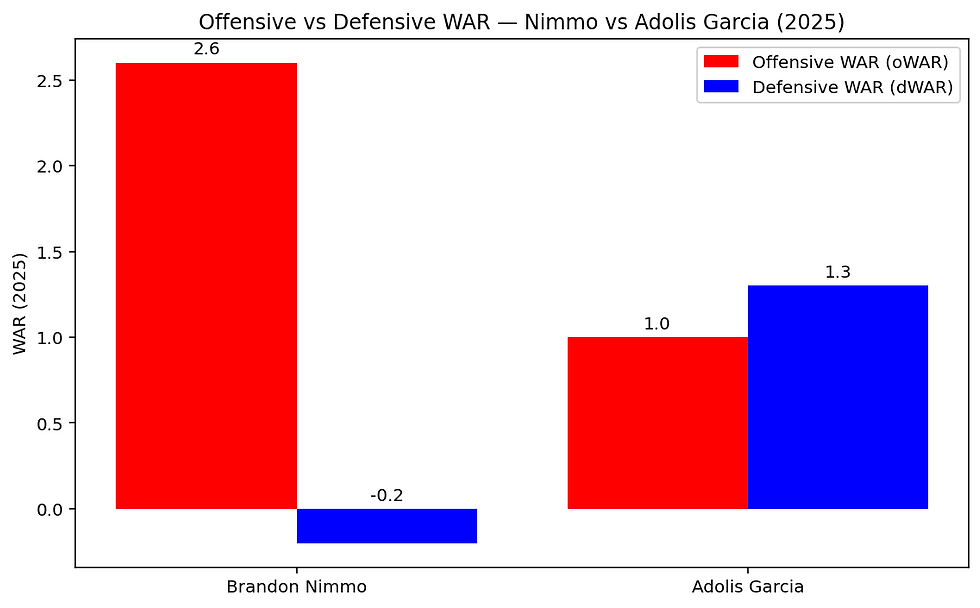
Below is a comparison of Brandon Nimmo and Adolis García's 2025 oWAR and dWAR according to Baseball Reference as Nimmo would essentially replace him in the outfield. Though Nimmo appeared in 20 more games than García there is still a tremendous difference in their offensive production and the 20 games would not have made up for it. Nimmo's substantially higher oWAR addresses the major offensive need for the Rangers.
To replace Semien at second base, the Rangers will likely turn to utility man Josh Smith, who can now transition to a full-time position after winning a Silver Slugger in 2024. They could also pursue external options such as free agents Gleyber Torres (though unlikely given his attachment of the qualifying offer) or Luis Arraez, who could contribute significantly to their run-scoring needs. However, Josh Smith remains the most probable solution.
The Mets' Perspective
The Mets also endured a disappointing 2025 season. After starting as one of baseball's best teams, they finished 83-79, 13 games behind the Phillies, and missed the Wild Card due to a tiebreaker loss to the Reds. Their most pressing need was defense and run prevention. They finished in the bottom half of the league in Outs Above Average (OAA), Fielding Run Value (FRV), Defensive Runs Saved (DRS), and total runs against.
The Mets also faced a positional logjam heading into 2026. Outfielder Carson Benge, their number two prospect, is on the verge of reaching the majors and in all likelihood will see playing time at some point this season. Neither Nimmo nor Juan Soto offers positional flexibility, with Soto in right field and Nimmo in left. This leaves Tyrone Taylor and potentially Jeff McNeil splitting time in center field, though McNeil is better suited for a corner outfield spot occupied by Nimmo and Soto. At second base, McNeil received most of the playing time in 2025 with occasional outfield appearances. The Mets also have a surplus of young infielders including Brett Baty, Mark Vientos, and Ronny Mauricio.
Marcus Semien is the ideal acquisition for the Mets, solidifying second base for the near future as their defensive-first player. Semien also saves the Mets approximately $24.5 million long term, calculated as the difference between Nimmo's and Semien's contracts minus the $5 million sent to Texas. While owner Steve Cohen has never made payroll an issue, the team values smart investments. This freed-up capital provides additional flexibility to pursue high-profile free agents such as Kyle Tucker, Cody Bellinger, Kyle Schwarber, or re-sign Pete Alonso though no signing appears imminent.
Semien is the perfect complement to Francisco Lindor up the middle. Over the past three years, he has posted a 1.0, 1.7, and 2.3 dWAR according to Baseball Reference. In 2025, when he recorded a 1.0 dWAR, he appeared in only 127 games after fracturing his foot in late August. He finished 2025 in the 82nd percentile in FRV with 6, 92nd percentile in OAA with 7, and recorded 5 DRS. Equally important to the Mets, he finished in the 86th percentile in Baserunning Run Value. Semien committed just two errors last year with a .996 fielding percentage, while Mets second baseman Jeff McNeil made six errors with a .984 fielding percentage. Semien also won his second Gold Glove in 2024. He embodies exactly what the Mets need in a defensive-first player and will anchor second base for the next three years.
Below is a comparison of Marcus Semien and Jeff McNeil's 2025 oWAR and dWAR according to Baseball Reference. McNeil is the logical comparison point, as Semien would essentially replace him at second base. Both players appeared in a similar number of games with Semien in 127 and McNeil in 122. The key difference lies in their defensive ability. Semien's significantly higher dWAR addresses a critical need for the Mets, as improved defense should help prevent runs and win more games in 2026. Additionally, Semien was slightly more productive offensively, though defense remains the primary reason for his acquisition.

Like Nimmo, the concern with Semien is potential age-related decline. His offensive profile is not a primary concern, as defense is the reason for his acquisition. By securing second base and trading Nimmo, the Mets now have multiple positional options. They can place McNeil in left field until Benge is ready, or they can sign a player like Bellinger or Tucker and package McNeil in a trade along with one of the surplus of infielders. The Mets now possess significantly more positional flexibility moving forward.
Conclusion
This trade represents a rare win-win scenario where both teams addressed their most pressing needs. The Rangers acquired offensive production and veteran leadership for their young outfield while maintaining financial flexibility. The Mets upgraded their defense, gained long-term payroll savings, and created positional versatility. Both organizations made these decisions that align with their competitive timelines and organizational philosophies and needs.


Comments